


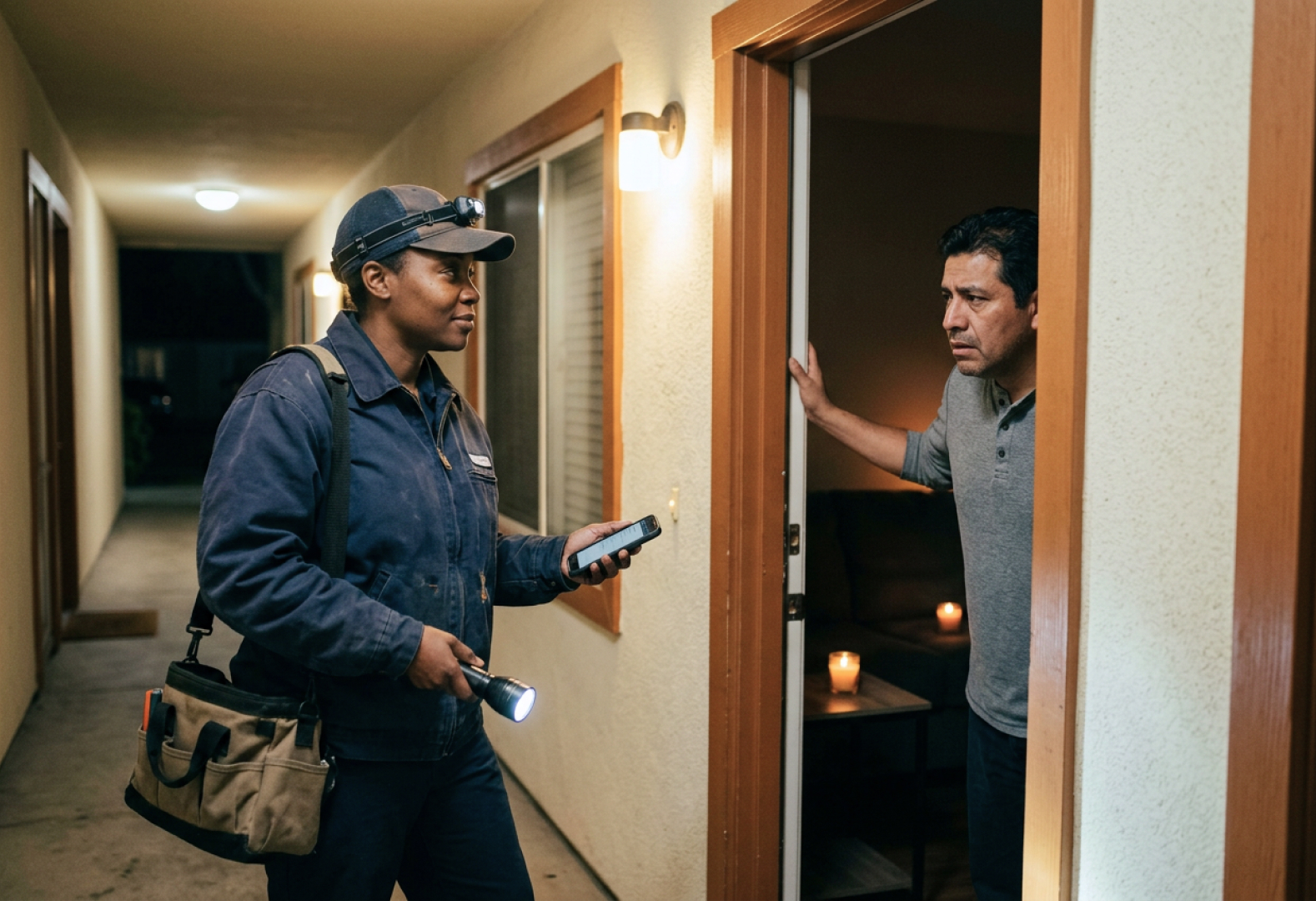


A burst pipe at 2 AM doesn't wait for business hours, and neither should your response. After-hours maintenance is the coverage property managers put in place to handle emergencies that happen outside the standard workday — nights, weekends, and holidays — without leaving residents stranded until Monday morning.
For multifamily operators managing hundreds of units across a portfolio, having a reliable after-hours maintenance plan isn't optional; it's what protects the property from water damage claims, angry resident reviews, and liability exposure that a delayed response can create. This guide walks through what after-hours maintenance support actually covers, how the workflow should work, and how to decide whether to staff it in-house or outsource it.
What Is After-Hours Maintenance?
After-hours maintenance is the process property managers use to respond to urgent maintenance issues — like no heat, flooding, or lockouts — that occur outside standard business hours. Effective after-hours maintenance support combines a clear emergency definition, a reliable communication system (phone, SMS, or app-based), and either an internal on-call rotation or an outsourced answering service and vendor network to make sure requests get resolved quickly, day or night.
What Is After-Hours Maintenance Support?
After-hours maintenance support is the system a property puts in place to receive, triage, and dispatch maintenance requests that come in outside normal office hours. It's not a nice-to-have add-on to your maintenance program — it's the part of the program that gets tested the most, because emergencies rarely wait for convenient timing.
Why After-Hours Maintenance Matters
A pipe that leaks all night causes exponentially more damage than one caught within the hour. After-hours maintenance support is what stands between a minor issue and a five-figure repair bill.
Difference Between Normal Maintenance and After-Hours Maintenance
Normal maintenance runs on a scheduled, non-urgent cadence — routine repairs, preventive work, and service requests logged during business hours and handled in the order they come in. After-hours building maintenance operates under a different set of rules entirely: speed matters more than sequencing, and the process needs to function without a full office staff on hand to manage it.
Why Property Managers Need After-Hours Maintenance
Water, electrical, and heating failures don't respect business hours, and residents increasingly expect a response regardless of when an issue happens. Beyond resident experience, after-hours emergency maintenance protects the property itself — a delayed response to a burst pipe or a gas smell creates liability that dwarfs the cost of maintaining coverage in the first place.
What Counts as an After-Hours Maintenance Emergency?
- No heat during cold weather
- Flooding or major water leaks
- Gas odor or suspected gas leak
- No electricity throughout a unit
- Broken locks or lockouts creating a security risk
- Fire or smoke conditions
What Is NOT Considered an Emergency?
- A dripping faucet
- A broken appliance that isn't a health or safety risk
- Cosmetic damage
- Noise complaints without an urgent safety component
- Requests for non-urgent repairs that can wait until business hours
The Complete After-Hours Maintenance Workflow
A resident's after-hours request should move through a clear sequence: intake (phone, app, or portal), triage against the emergency definition, dispatch to an on-call technician or vendor, resolution, and documentation. Every step needs a clear owner, especially at 2am when nobody wants to guess who's supposed to act.
How After-Hours Maintenance Support Works
Most after-hours maintenance support runs through either an internal on-call rotation, a third-party answering service, or a hybrid model where an answering service handles intake and an internal or vendor technician handles dispatch. Whichever model a property uses, the resident experience should feel seamless — a fast answer and a clear timeline, regardless of what's happening behind the scenes.
Types of After-Hours Building Maintenance
- Plumbing emergencies
- HVAC and heating failures
- Electrical outages
- Lockouts and security issues
- Fire and life-safety incidents
- Pest emergencies (e.g., wasp nests, rodent intrusion into living space)
Benefits of Professional After-Hours Maintenance Support
- Faster response times during genuine emergencies
- Reduced property damage from delayed repairs
- Improved resident satisfaction and retention
- Lower liability exposure
- Consistent documentation for every after-hours call
How Property Managers Prioritize Maintenance Requests
Prioritization should follow the same written emergency definition every time — safety and property-damage risks first, comfort issues second, and everything else routed to the next business day. Consistency here matters as much as speed; residents notice when the same type of issue gets handled differently depending on who's on call.
Communication During After-Hours Emergencies
- Emergency phone systems
- Call centers
- SMS alerts
- Maintenance portals
- Resident apps
- Internal escalation
- Vendor communication
- Documentation
Should You Outsource After-Hours Maintenance?
FactorKeep In-HouseOutsourceCostLower per-incident cost if volume is highPredictable monthly fee, no overtime staffingAvailabilityLimited by staff schedules and burnout risk24/7 coverage guaranteed by contractCoverageDepends on team size across the portfolioScales automatically across every propertyVendor expertiseLimited to your existing vendor relationshipsBroader vendor network, especially for rare tradesLiabilityProperty retains full responsibilityShared liability, depending on contract terms
How to Choose the Right After-Hours Maintenance Provider
Look for a provider with real multifamily experience, documented response-time guarantees, a vendor network that covers every trade your portfolio needs, and reporting that gives you visibility into every after-hours call — not just a monthly invoice.
Common Mistakes Property Managers Make
Treating every after-hours call as equally urgent, failing to document calls consistently, relying on outdated vendor contact lists, and not reviewing after-hours performance data until something goes badly wrong are the mistakes that show up most often.
Challenges Property Managers Face
Staffing on-call rotations without burning out maintenance teams, keeping vendor availability current across a large portfolio, and maintaining consistent documentation across every shift and every property are the recurring challenges in after-hours maintenance.
KPIs to Measure Success
- Response time
- Resolution time
- First-time fix rate
- Emergency frequency
- Tenant satisfaction
- Maintenance cost
- Repeat repairs
- Vendor performance
- Downtime
- Compliance
FAQs
Is a Leaking Pipe Considered an Emergency?
Yes — any active water leak is treated as an after-hours maintenance emergency because of how quickly it can escalate into structural or resident-property damage.
How Much Does After-Hours Maintenance Support Cost?
Costs vary widely based on portfolio size and whether coverage is staffed in-house or outsourced, ranging from a flat monthly answering-service fee to the cost of an internal on-call rotation with overtime pay.
Can an Answering Service Dispatch Maintenance Technicians?
Yes — most answering services triage the call against a pre-set emergency policy and then dispatch to an on-call technician or approved vendor based on the type of issue.
Do After-Hours Maintenance Services Work on Weekends and Holidays?
Yes, weekends and holidays are exactly when after-hours maintenance coverage matters most, since regular office staff aren't available.
What Software Is Used for After-Hours Maintenance Management?
Property teams typically use maintenance management platforms that log requests, route them to on-call staff or vendors, and track resolution — giving both residents and management visibility into every step.
Lauren Seagren is the Content Marketing Specialist at HappyCo, where she leads the company’s content strategy and storytelling across channels. She develops and optimizes campaigns, blogs, case studies, and enablement materials, while building the systems that help content scale and align across teams. Prior to HappyCo, Lauren led content and brand strategy across SaaS startups, creative agencies, and growth-stage companies, bringing more than a decade of experience driving measurable growth across B2B and B2C organizations.


