




Why Your Tech Stack Is Probably Broken
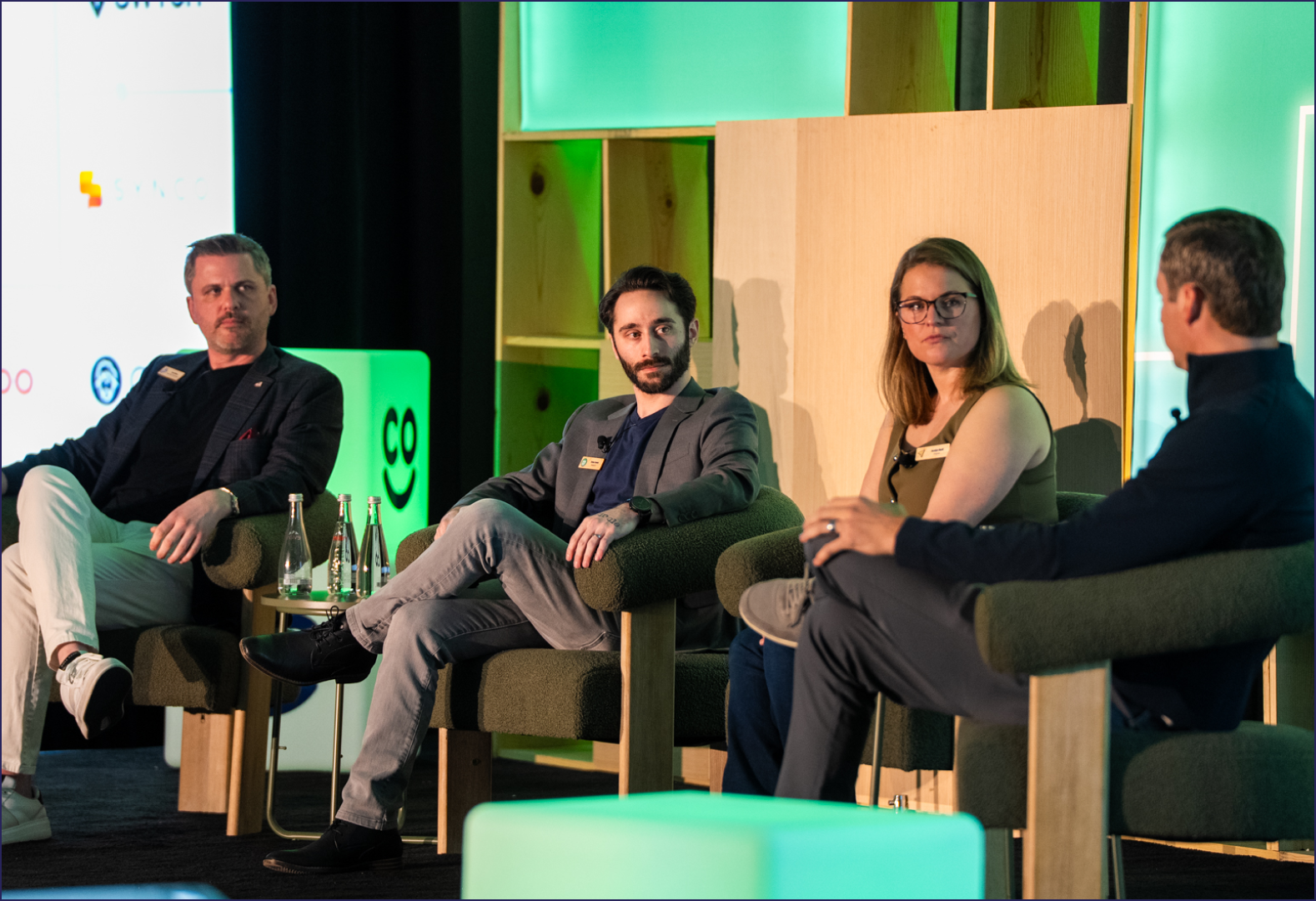
At Happy Summit 2026, the audience was asked a challenging question: How many of you have wanted a true single source of truth for your property data? A sea of hands went up, followed by a shared moment of recognition when the speakers shared Reddit threads documenting the actual stress operators face while fighting to extract usable data from their PMS. The laughter in the room confirmed that these struggles were all too familiar.
This was the setup for a fast-moving conversation between James Gaeta (Head of Integrations & Partnerships, HappyCo), Scott Hines (Director, Systems & Applications, Mark-Taylor Residential), Jocelyn Quall (VP of Marketing, Engrain), and Ethan Lacey (Founder & CEO, Union) about what a genuinely connected tech stack looks like — and the mindset shift required to get there.
Mark-Taylor Residential: The Ghost Hours Problem
Scott Hines of Mark-Taylor Residential introduced the session's most notable concept: ghost hours. These are the invisible time costs that accumulate when systems aren't properly connected — the extra tab, the manual re-entry, or the click that shouldn't exist. Individually they seem trivial. Aggregated across a centralized team managing 40,000 units, they become a significant operational drag.
“Ghost hours are always kind of hard to quantify. It's an extra tab here, an extra click there, having to do manual stuff because the PMS can't have the same functionality you'd get going directly across.” — Scott Hines | Director, Systems & Applications, Mark-Taylor Residential
The underlying cause: the traditional integration model forces data through an unnecessary middleman — the PMS — creating a bottleneck triangle between the PMS, building management systems, and every other tool in the stack. Scott's prescription was blunt:
The Triangle vs. The Direct Line
Traditional model: Every integration routes through the PMS — adding cost, complexity, and latency at every step. The PMS vendor profits; everyone else suffers.
Mark-Taylor’s model: Skip the middleman. Connect systems directly via open APIs. Better functionality, better data, and better resident experience — with no PMS toll booth in between.
The Centralization Amplifier
Scott also highlighted a dynamic unique to centralized operations: scale cuts both ways. When a centralized team gets integration right, the efficiency gains are exponential. When something breaks or a bad change rolls out, the damage is equally amplified — hitting multiple departments simultaneously instead of one site. This means testing rigorously before deployment isn't optional, it's existential.
Seeing Is Knowing: Engrain's Maintenance Maps
Jocelyn Quall from Engrain brought a simple but powerful idea to the stage: stop drowning your team in data and start giving them insight. Interactive maintenance maps, embedded directly inside HappyCo, let teams visualize work orders by building, floor, urgency, and service category — in real time.
10,000 Maps. Free Activation.
Engrain announced the deployment of 10,000 interactive maintenance maps within HappyCo's platform by the end of March 2026. Activation is free — and if every operator in the room requests their properties, that number could double. No additional platform. No switching tabs. The map is embedded directly in HappyCo.
The case for visual data isn't just aesthetic — it's cognitive. A pattern that would take hours to find in a spreadsheet can be immediately obvious on a map. Jocelyn offered a real-world illustration.
“You thought you had an inconspicuous fridge leak. But what you actually had was a fridge leak with a fried outlet in a neighboring unit and water damage beneath it. On a spreadsheet you miss that pattern. On a map, you see it immediately.” — Jocelyn Quall | VP of Marketing, Engrain
What Maps Unlock for Your Team
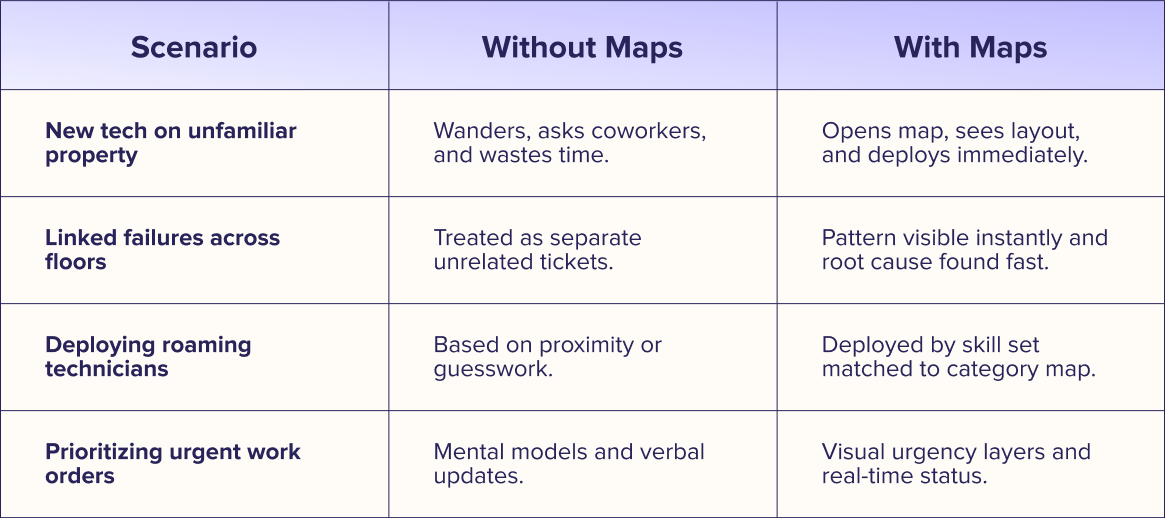
Scott confirmed that Mark-Taylor Residential is rolling this out now, and Engrain expects to share 30, 60, and 90-day operational impact data as results come in. The expected downstream effects: higher renewal rates, better retention, and more efficient technician deployment across national portfolios.
The Resident Call: Union's Unified Renter Journey
Ethan Lacey from Union addressed the other side of the resident experience equation: what happens when a resident picks up the phone. In most operations today, the person answering that call — human or AI — is working without full context. Work order status is in one system, notes are in another, and renewal timeline is somewhere else entirely.
Union's Single-Tab Approach
Union manages the entire renter journey from one interface: websites, CRM, lease management, renewals, AI agents, AI automation, delinquency management, and inbound resident calls. Every piece of the resident relationship — in a single tab, sitting on top of PMS data.
The integration with HappyCo fundamentally changes the quality of those resident conversations. When a resident calls about a work order, the agent — human or AI — has immediate access to status, history, notes, and context. Resolutions are faster. Relationships improve.
“The ability and quality of your teams to manage those conversations is entirely dependent upon the quality of the data you receive from tools like HappyCo.” — Ethan Lacey | Founder & CEO, Union
Sentiment Scores: The Retention Early Warning System
One of the most forward-looking integrations discussed was Union's resident sentiment scoring, now embedded directly in HappyCo. This gives maintenance teams context that goes far beyond the work order itself:
- Is this resident renewing in the next 47 days?
- Has someone in the unit submitted multiple service requests that went unresolved?
- Are their satisfaction scores trending down heading into the renewal season?
The integration brings that signal directly to the people closest to the resident: the maintenance team.
“What if your HappyCo tech can see that this resident is renewing in 47 days? The last survey was great, but someone else in the unit has been unhappy and had a couple of service requests that took a long time? That's the type of power an open API ecosystem gives you.” — James Gaeta | Head of Integrations & Partnerships, HappyCo
The Open Ecosystem Vision
The final section of the session was the most strategic — and the most candid. Scott drew a clear line between the old model (PMS as gatekeeper) and the new one (open, distributed, and partner-driven).
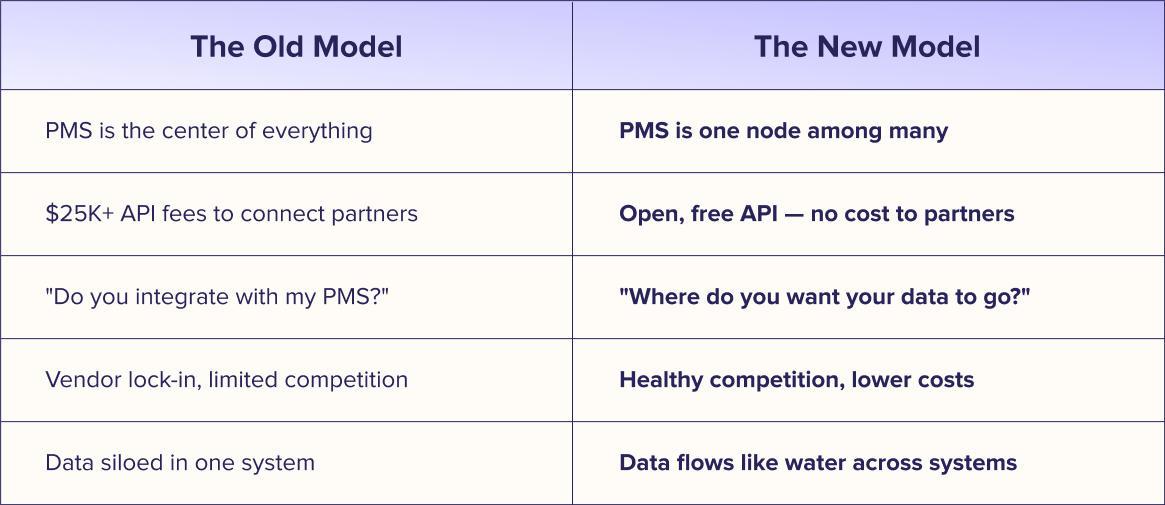
HappyCo's API by the Numbers

The API is fully open and free — to partners and operators alike. New integrations can be activated by flipping a switch in the platform. And if your software isn't on the list yet, HappyCo is dedicated to rapidly opening the API.
The Mindset Shift
James closed the session with a challenge to the entire room — and it was aimed squarely at a reflex that has become industry muscle memory.
Stop Asking the Wrong Question
"Do you integrate with my PMS?" — almost every hand in the room went up when asked how often they ask this on vendor calls.
James's challenge: retire that question entirely.
The better questions are:
- Where do you want your data to go?
- How do you want it to get there?
- Which best-in-class tools do you actually want in your stack?
Jocelyn from Engrain put the philosophy in its simplest terms — a reminder that all the integration complexity ultimately serves one purpose:
“We're in a B2B2C business. We sometimes lose sight of what's really at stake, which is resident happiness, resident occupancy, resident experience overall. We're here to serve the residents. That's why the ecosystem works. That's why the APIs are open. That's why the integrations are so effective.” — Jocelyn Quall | VP of Marketing, Engrain
Ready to Activate?
HappyCo's API ecosystem is open and free.
Check the current partner list, request activation of any software you're already using, and flag any partners not yet on the list — HappyCo commits to opening the API for them quickly.
Lauren Seagren is the Content Marketing Specialist at HappyCo, where she leads the company’s content strategy and storytelling across channels. She develops and optimizes campaigns, blogs, case studies, and enablement materials, while building the systems that help content scale and align across teams. Prior to HappyCo, Lauren led content and brand strategy across SaaS startups, creative agencies, and growth-stage companies, bringing more than a decade of experience driving measurable growth across B2B and B2C organizations.


