


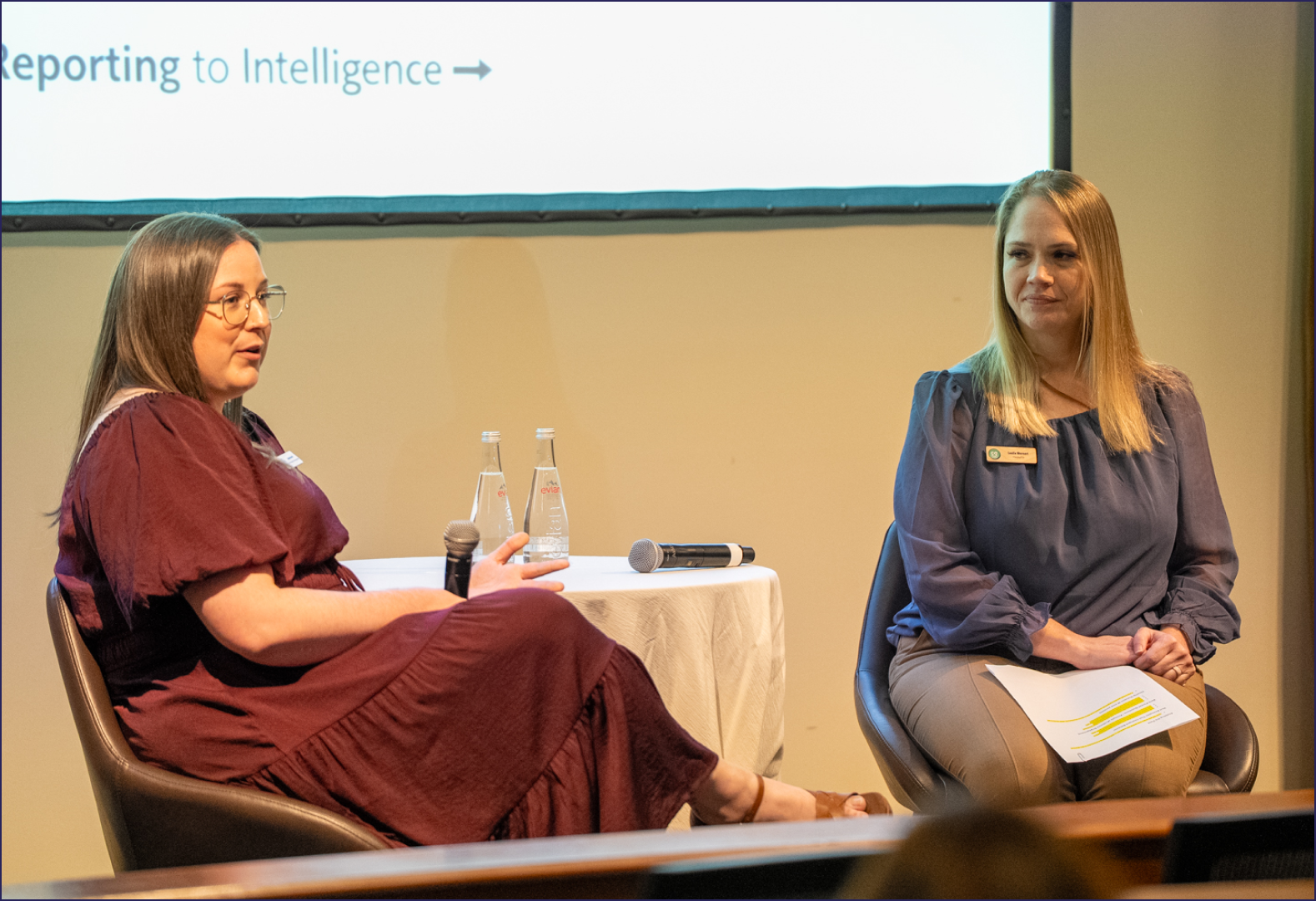


When Inspections Stop Being Checkboxes
At Happy Summit 2026, this session was framed as a conversation about progress, not perfection. Almost every property management company collects inspection data. Far fewer actually use it. The central question asked: once you've done the inspection, what do you do with what you found?
Price Brothers (12,000 units, centralized, and owner-operated) System Strategy Lead, Jordan Arend, walked through a three-year journey with HappyCo — from paper forms in binders to dashboards, vendor tracking, inventory management, and a growing set of KPIs pushing toward predictive analytics. The session was honest about what worked, what didn't, and what's still being figured out.
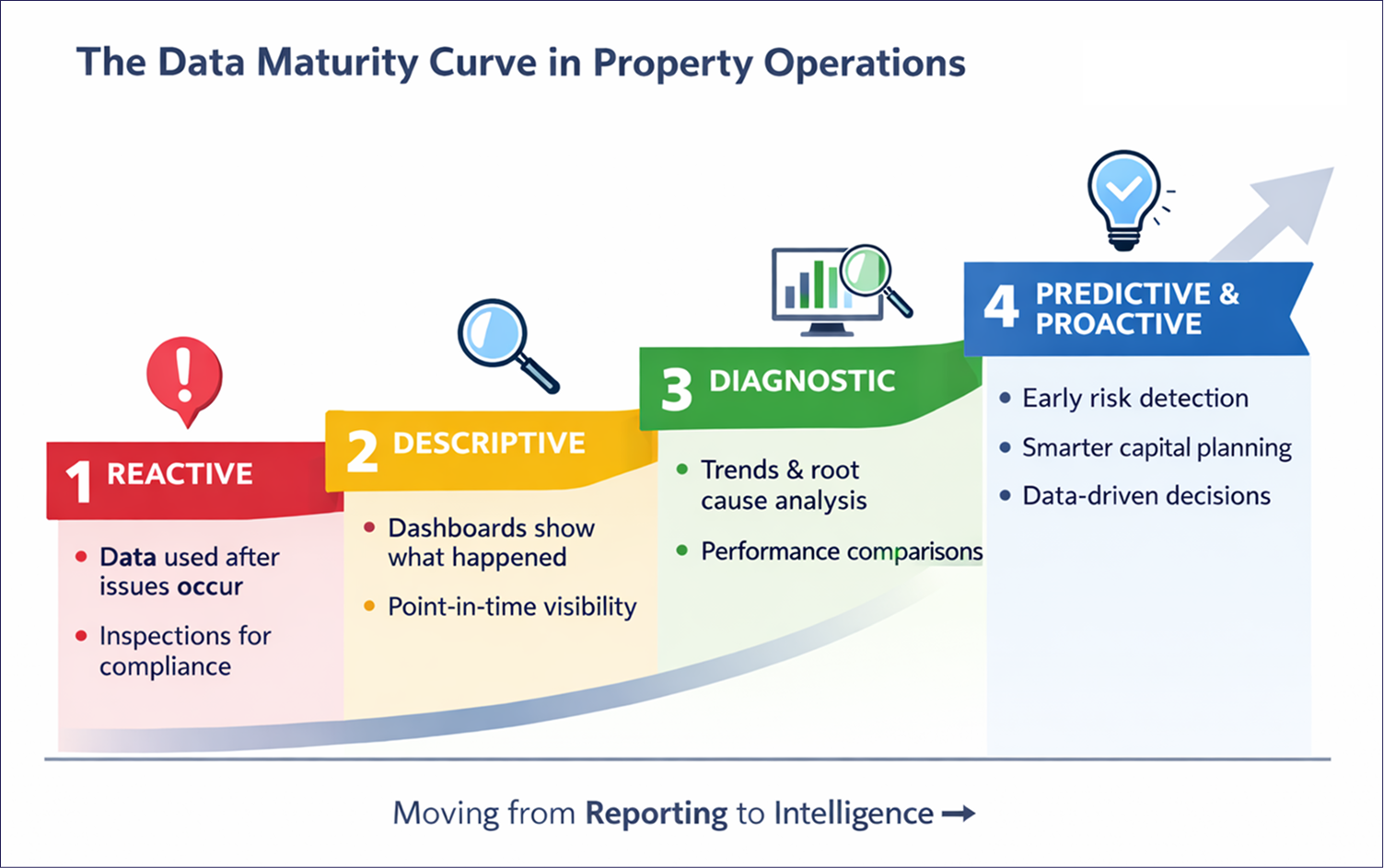
The Data Maturity Curve
Leslie Wernert, Senior Manager, Strategic Customer Programs at HappyCo opened with a framework she calls the Data Maturity Curve — four stages that describe where any property management operation sits in its relationship with inspection data. The goal of the session wasn't to get everyone to Stage 4 immediately. It was to help people identify where they are and take one clear step forward.
“We're not talking about perfection — just progress. Be confident in where you are, but not comfortable in where you are.”— Leslie Wernert | Senior Manager, Strategic Customer Programs, HappyCo
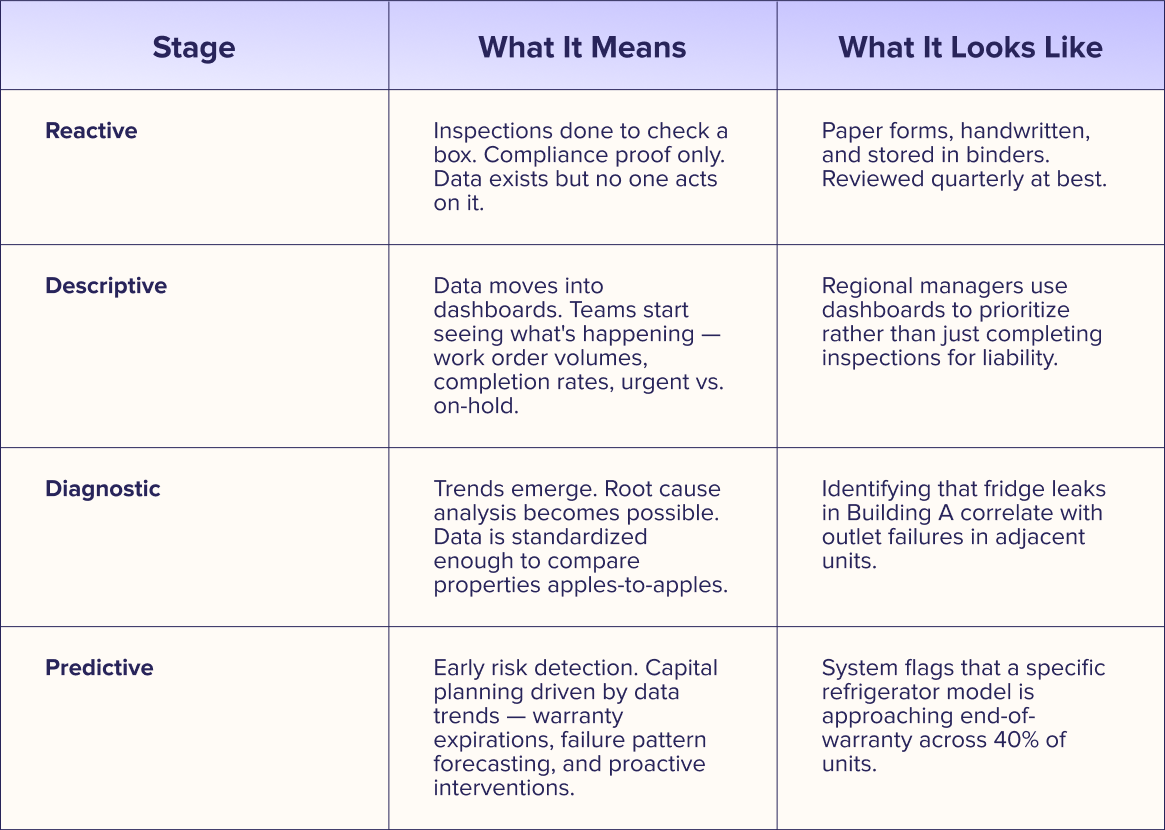
Price Brothers started, like most operators, at Stage 1. Every inspection was paper. Handwritten. Scanned occasionally, emailed sometimes, always filed in binders. Regional managers might glance at them once a quarter. The catalyst for change: COVID-19 forced the need for remote access and mobile inspection capability — and that push toward digital created the foundation for everything that followed.
“Inspections were just compliance. Making sure we had the liability covered, that somebody was putting eyes on something at a certain time. It was not a priority — it was an obligation.”— Jordan Arend | System Strategy Lead, Price Brothers
What Price Brothers Actually Built
The journey from Stage 1 to where Price Brothers sits today wasn't one big transformation — it was a series of deliberate, feedback-driven decisions. Jordan walked through each major evolution.
Step 1: The 1-to-1 Migration
The first move was the simplest and most important: take everything that existed on paper and put it into HappyCo exactly as-is. No redesign, no optimization — just digitization. The goal was to get the team comfortable with the new system without changing what they were inspecting. Once the data was in the system, the question changed from "how do we do this?" to "what do we actually do with this?"
Step 2: Tailored Dashboards by Role
The first major insight from having data in the system: different teams need different views. Price Brothers discovered they had regional managers, maintenance supervisors, and loop supervisors all looking at the exact same data at the same time — slightly different perspectives on the same metrics, generating noise without generating clarity.
The fix came from listening. Jordan's team asked regional managers directly: what do you actually need to see?
What Regionals Actually Wanted
Not: how many work orders are open today.
Yes: when were they completed and how quickly? How many urgent work orders vs. those put on hold for CapEx?
That distinction — speed and escalation pattern — was the signal that helped regionals keep their teams accountable.
Step 3: Vendor Work Order Tracking at Scale
With a heavy reliance on external partners for everything from mitigation to painters to carpet replacement, Price Brothers manages a massive volume of third-party work. Jordan noted that the sheer quantity of vendor work orders was eye-opening once the data was finally aggregated.
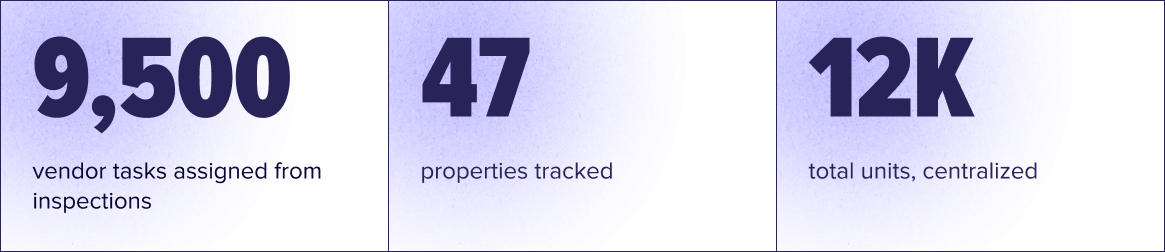
To manage this, they implemented custom dashboard widgets designed to strip away noise. By filtering tasks by category, specialists like CapEx planners or pest control teams only see the specific data points relevant to their roles, replacing data overload with actionable signals.
Step 4: Inventory Management for Capital Planning
The newest frontier for Price Brothers is using inspection photos and barcodes to track physical assets — appliances, fixtures, and equipment as they move through the portfolio. The problem it solves is one that anyone managing a large portfolio knows intimately.
“They have a spreadsheet of all the appliances installed. But that refrigerator moved from this unit to that unit because the first was vacant and they needed the part — and that was never tracked. Now they're going to replace six refrigerators and they walk into the unit and it's not there. It’s a wild goose chase.” — Leslie | Senior Manager, Strategic Customer Programs, HappyCo
HappyCo's inspection data tracks the item from unit to unit, maintaining its maintenance history along the way. For capital project planning, this transforms a guessing game into a reliable asset register — one that captures warranty expiration dates, movement history, and maintenance records in a single place.
The Data Overload Trap
One of the most honest moments in the session came when Jordan described what happened when Price Brothers first built out their dashboards: they put too much in.
The fix was feedback loops — asking teams what they actually needed, not what leadership assumed they needed. Several practical techniques emerged from the conversation:
Rotating quarterly focus
Instead of the same inspection every quarter, each quarter has a different priority focus. Same compliance coverage, but with rotating emphasis that makes each inspection feel intentional rather than repetitive.
Remove duplicate questions
Price Brothers found questions being asked in three separate inspections without realizing the data was already being collected elsewhere. Eliminating redundancy reduced burden without reducing coverage.
Budget rating buttons
For capital planning inspections, adding a simple "budget" tag to items lets regionals run a single insight report with everything that needs future investment — no manual sorting required.e.
Keep templates narrow
HappyCo data shows inspections with more than 80 items have a significant drop in completion rates. Price Brothers keeps site team inspections short and compartmentalized; broader annual inspections are reserved for regional teams.
The 80-Item Rule
HappyCo's platform data is clear: once an inspection template exceeds 80 items, completion rates drop significantly. The practical implication — give site teams several focused, digestible inspections rather than one comprehensive template. Save the comprehensive view for regional-level annual reviews.
The Template Strategy Debate
The audience Q&A surfaced one of the most practical and frequently debated questions in inspection management: should you have one master template for the entire portfolio, or separate templates by property type?
Leslie's answer was nuanced — it depends on the inspection type:
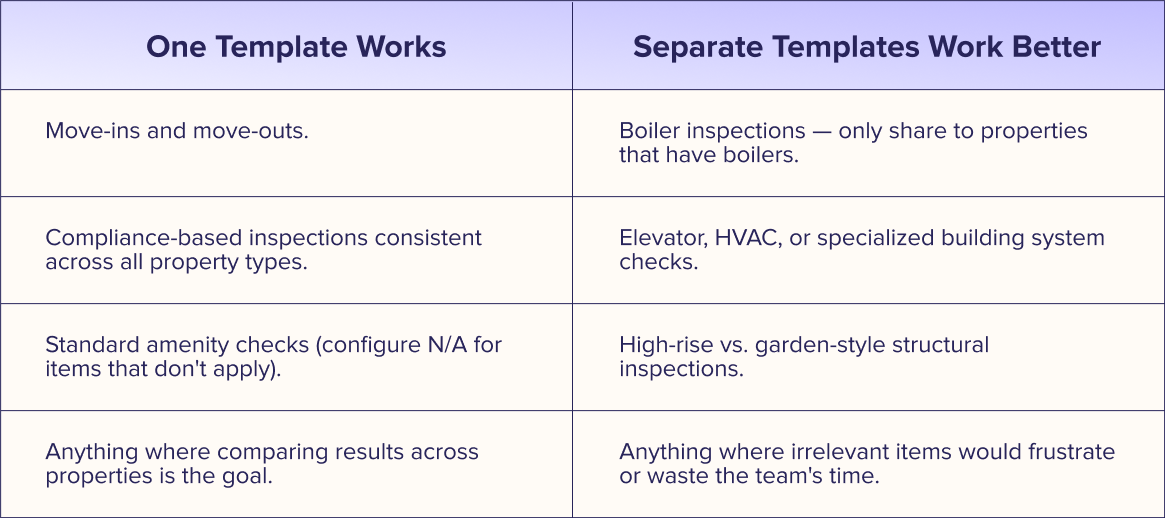
One audience member raised the "death by templates" risk — if you have 15 inspection templates and legislation changes, you're updating 15 files instead of one. Leslie agreed: the goal is to have the minimum number of templates needed to produce clean, useful data. Pre-populating common answers and using skip logic can handle most variations within a single template without multiplying overhead.
The Real Work — Getting Teams to Actually Use It
Technology adoption is where most inspection programs fail — not in the technology itself, but in the human systems around it. The session's most candid discussion was about change management and sharing what actually works.
What Doesn't Work: Top-Down Mandates
The consensus across all speakers was direct: mandates don't produce good behavior. They produce minimum compliance and maximum resentment. Jordan's framing was clear — the goal is grassroots buy-in, and that starts with explaining the why before issuing the what.
“I don't think mandates enforcing things are going to yield good behavior. It's more about building consensus from the grassroots.”— Jordan Arend | System Strategy Lead, Price Brothers
What Works: Personal Stakes
One audience member described what actually moved the needle in their rollout: making it personal. Not "this is great for the company" — but "here's how it saves you time today."
What Works: Camera-First and Voice-First Features
Jordan shared one product change that made a huge difference for less tech-savvy team members: camera-first inspections.
Previously, maintenance staff traded their familiar clipboards for a mobile app, which created friction, especially for non-native English speakers. The new camera-first feature simplified the process, making adoption much smoother.
Now, an upcoming voice-first inspection capability is set to break down barriers even further. This feature will allow technicians to capture data simply by speaking, eliminating the need for typing and making it easier for multilingual teams to work together seamlessly.
“Camera-first inspections were huge. That small change has been amazing for our teams. We have people who are not tech savvy. Now we're able to say: here's a new feature to make your jobs easier.”— Jordan Arend | System Strategy Lead, Price Brothers
Here are a few other methods that companies in the room have found success with:
- Weekly recognition for quality service requests; monthly recognition for consistent inspection completion.
- Quarterly property visits where HappyCo performance is evaluated and reviewed.
- Monthly roundtable calls (1 hour, managers and supervisors) where 80% of the agenda is inspection process and HappyCo usage.
- Half-day onboarding for new team members specifically on HappyCo — even if brief, it sets expectations from day one.
The Feedback Loop That Drives Product
Leslie shared something that reframed how operators should think about their relationship with HappyCo as a product: user feedback isn't just collected — it's acted on. Every 90 days, a pop-up in the app asks users to rate their experience. Those ratings are reviewed daily by the team and also reviewed by HappyCo’s senior leadership.
Your Maintenance Team's Comments Are Shaping HappyCo
Every app review is read. Camera-first inspections didn't come from HappyCo's product team — it came from operators telling them their maintenance staff was struggling. The same is true for voice-first. If your team is frustrated with a feature, that feedback has a direct path to the product roadmap. Submit it.
Free Resources You Might Not Know About
Leslie closed with a reminder — a set of free, monthly training resources available to all HappyCo customers:
Newcomer App Session
Free monthly training for new maintenance team members. Covers app basics including logging in, completing inspections, and submitting work orders. To ensure team members feel comfortable asking candid questions, these sessions don’t require supervisor attendance.
Insights Reporting Session
Free monthly session on pulling data from HappyCo dashboards. How to build custom reports, update existing dashboards, and extract the metrics your team actually needs. Available to Admins with Insights access.
There are always more monthly training sessions available. Find the schedule in our Help Center.
Lauren Seagren is the Content Marketing Specialist at HappyCo, where she leads the company’s content strategy and storytelling across channels. She develops and optimizes campaigns, blogs, case studies, and enablement materials, while building the systems that help content scale and align across teams. Prior to HappyCo, Lauren led content and brand strategy across SaaS startups, creative agencies, and growth-stage companies, bringing more than a decade of experience driving measurable growth across B2B and B2C organizations.


