





When you manage 1.1 million multifamily units across multiple PMS systems, a "standard" software rollout isn't standard at all. It's a logistics challenge, a change management challenge, and a political challenge all at once, with 30,000 stakeholders who each have an opinion about how things should be done.
At Happy Summit 2026, Leah Rimpler — Senior Director of Property Systems at Greystar — sat down for a candid fireside chat with Christina Fox, HappyCo’s VP of Strategic Customer Programs, about how her team is pulling off one of the largest tech implementations in multifamily history. Their conversation was a masterclass in the work that goes into every successful large-scale implementation.
The result: a repeatable playbook that works whether you manage 5,000 units or millions.
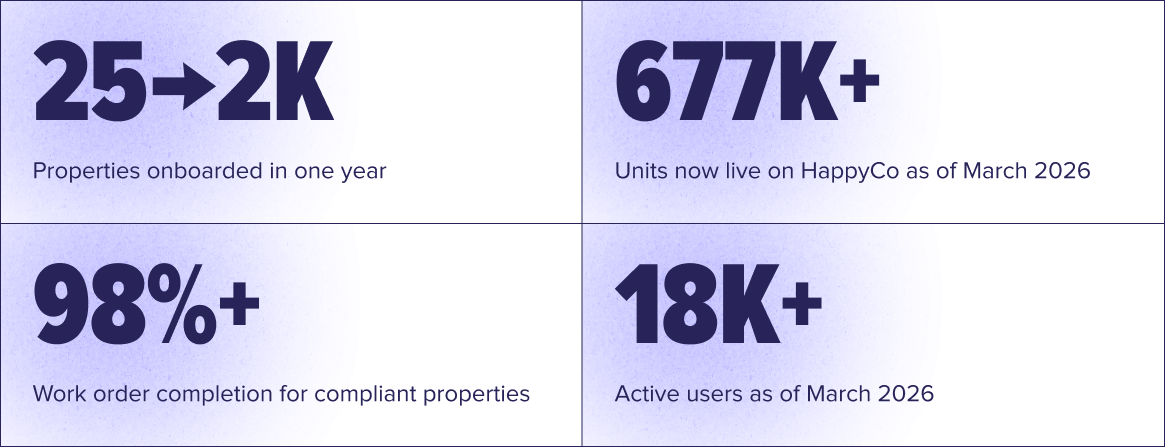
From 25 to 2,000 Properties in 12 Months
At the start of 2025, Greystar had roughly 25 properties on the HappyCo platform. By the end of the year they had 2,000 properties, 550,000 units, and 15,000 active users all utilizing HappyCo. And the plan for 2026 is to essentially double that again. That kind of growth doesn't happen by accident, and it doesn't happen without stress-testing every part of the partnership.
“We have a tendency to break vendors — and I don't say that as a flex. There are a lot of vendors that are very excited to get our business, but we can be hard to work with. It can be very demanding.” — Leah Rimpler | Sr. Director, Business Applications & Product Management, Greystar
Before committing to any technology at scale, Greystar evaluates one core question: can this vendor actually grow with us? The pilot phase isn't just a proof-of-concept — it's a deliberate test of the vendor's ability to handle the volume, the complexity, and the organizational noise that comes with a large rollout.
The Pilot Is the Playbook
Greystar's approach: take whatever worked in the pilot and ask, how do we magnify this by a million? Every decision in the scaled rollout traces back to what was proven in the test. This isn't conservative thinking — it's how you avoid creating a new set of problems at 10x the scale. If the process wasn't repeatable and stable in the pilot, it won't survive the full deployment.
The rollout itself used the same process any operator would use — no shortcuts, no special treatment. What made it work at Greystar's scale was the discipline around how they set it up, not any special technical magic.
30,000 Voices: Managing Stakeholders Without Losing Your Mind
A portfolio the size of Greystar's comes with a lot of smart, opinionated people. Regional leaders, property managers, and business unit heads. Each of whom has legitimate ideas about how the technology should work for their specific context. Left unmanaged, this diversity of input becomes a liability for the vendor relationship.
Greystar's solution: a dedicated product management team — just two full-time employees — whose primary job is to serve as the single communication channel between Greystar's 30,000 employees and HappyCo. All feature requests, all support tickets, and all strategic tasks flow through them first.
The Guardrail Model: Two People, 30,000 Stakeholders
Two full-time employees manage the entire HappyCo relationship for a company of 30,000 people. Their job isn't just to process requests — it's to protect the vendor from being overwhelmed by well-intentioned, but uncoordinated demand. By filtering and prioritizing before anything reaches HappyCo, they keep the partnership focused on what matters most. Greystar absorbs the "no" internally, protecting the vendor's reputation in the process.
Standardization Over Customization: The "Standard Settings" Playbook
One of the most counterintuitive decisions Greystar made was to say no to customization — even when the people asking had legitimate reasons. Operating across multiple PMS systems (RealPage, Yardi, and Entrata), the temptation is to tailor each configuration to each system and each region's preferences. Greystar explicitly chose not to.
“We call it our standard settings. Think of it like a playbook — this is how the property is going to get set up. We chose HappyCo because it works across all PMS systems. But to protect that and scale it in a standardized way, we had to make some tough decisions.”— Leah Rimpler | Sr. Director, Business Applications & Product Management, Greystar
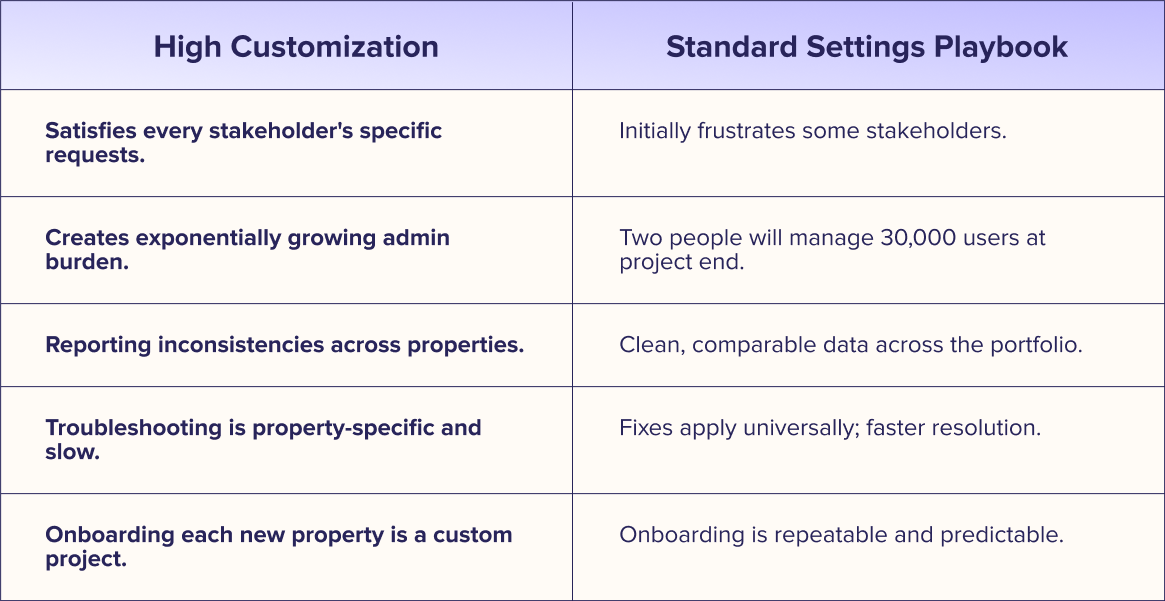
The standard settings playbook defines exactly how every property gets configured — same templates, same categories, and same workflows. The only exceptions are legally required: California's mandatory photo documentation for move-out inspections, for example. And when a legal requirement emerged in one state, Greystar extended it nationwide rather than creating a state-specific carve-out.
When California law required move-out photos, Greystar made it the national standard — because it protects everyone, and it keeps the platform uniform.
The business case for standardization is straightforward: with only two full-time staff managing the entire platform — every custom template, every segmented configuration, and every one-off adjustment is time that cannot be spent on other priorities. Stability in reporting, cleaner data, and a more predictable user experience are the operational dividends.
A Call to Action for Admins
Every customization creates a maintenance burden. Before building out 15 different move-out templates or region-specific work order categories, ask: what is this actually buying us — and who is going to maintain it? The value of a unified platform compounds over time only if the configuration is consistent enough to generate comparable data across properties.
The Three Change Management Lessons That Changed Everything
Running simultaneous technology rollouts across a company of 30,000 gave Greystar an unusual opportunity: a live A/B test of change management approaches. What Leah observed became the foundation of how her team thinks about every implementation.
01 | People Don't Buy What They Don't Understand
Product A had clear stakeholder buy-in from day one because everyone understood why the switch was happening. Product B launched with fuzzy rationale and met resistance at every turn. The "why" isn't a nice-to-have — it's the prerequisite for adoption. If your team can't articulate it in one sentence, you haven't communicated it yet.
02 | Your Team's Language Becomes Leadership's Reality
When Leah's team presented problems as crises, leadership went into red-flag mode. When they framed the same issues as normal parts of change, the response was steady and measured. The tone of internal communication directly shapes how executives perceive the rollout. This shapes their support, their patience, and the resources they'll allocate.
03 | Negative Sentiment Outlasts the Problem by Months
Issues that surfaced in month one were still being referenced six or seven months later — long after they'd been resolved. Regardless of a company’s size, bad news travels fast and stays in circulation. Managing the narrative isn't about spinning a story. It's about acknowledging a fundamental truth: perception and reality are two different things.
If you don't bridge that gap, it will only widen over time.
The Simplest Success Metric: Are They Using It?
Most technology rollouts burden users with complex KPIs from day one: completion rates, first-time fix percentages, turnaround time benchmarks. Greystar did something different. For the initial rollout, the only question that mattered was: are you completing your work orders in HappyCo instead of your old system?
“Take out your notepads, because there's a lot of metrics. No — I'm joking. We only measured one thing: are you using it? Are you doing the work orders in this system and not the old system? If you were, you win. Good job.” — Leah Rimpler | Sr. Director, Business Applications & Product Management, Greystar
The logic is behavioral: users who are already exhausted by change management don't need another complex scorecard. They need to know exactly what success looks like and feel confident they can achieve it. One clear action — complete your work orders here — lowers the anxiety threshold and builds the habit that makes everything else possible.
Habit comes before performance. Build the habit first, measure the performance later.
The result: HappyCo has observed a growing volume of properties reaching 98–100% work order completion within the platform as Greystar’s implementation progresses. That foundation makes the next phase — expanding into make-ready, move-in, and move-out inspections — far easier to execute, because users are already in the system every day.
Phased Expansion: Earn the Right to Add Complexity
Greystar's roadmap is deliberate: work orders first (establish the habit), then inspections (leverage the habit). Each phase builds on established user behavior rather than asking people to change multiple things at once. Future rollout of AI capabilities becomes easier because the muscle memory already exists. Operators expanding feature sets should follow the same sequencing — not because it's safer, but because it works.
Lauren Seagren is the Content Marketing Specialist at HappyCo, where she leads the company’s content strategy and storytelling across channels. She develops and optimizes campaigns, blogs, case studies, and enablement materials, while building the systems that help content scale and align across teams. Prior to HappyCo, Lauren led content and brand strategy across SaaS startups, creative agencies, and growth-stage companies, bringing more than a decade of experience driving measurable growth across B2B and B2C organizations.


