




Setting the Stage
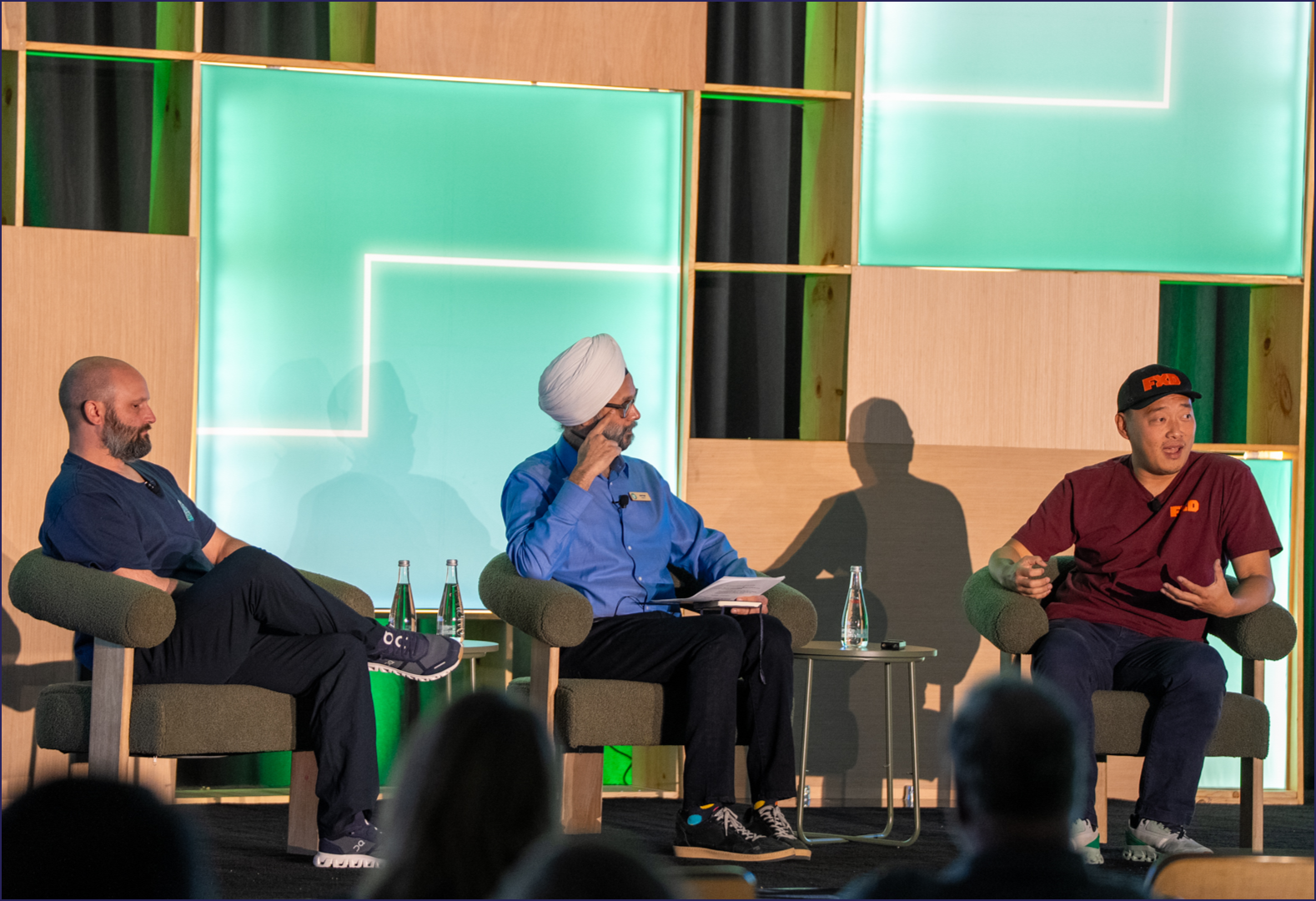
The agents are coming. That was the opening line that set the tone for one of Happy Summit 2026’s most energizing sessions. In this fireside chat, Jindou Lee, HappyCo’s CEO & Co-Founder sat down with HappyCo leadership members Sukhi Singh, Chief Strategy Officer (CSO), and Ben Nowacky, President to unpack a question every multifamily operator is quietly wrestling with: how do you lead an organization through a technology shift that’s moving faster than anyone can fully track?
The conversation was candid, funny at times, and surprisingly honest about the fear, uncertainty, and raw excitement that comes with navigating the AI era in property management.
The Fear Is Real: Barriers to AI Adoption
When Sukhi asked Ben what he’s actually hearing from customers in the field — not the polished version, but the real one — the answer was refreshingly blunt. People with 30 years of experience are skeptical. And the ones who aren’t skeptical are paralyzed by choice.
The Two Barriers to AI Adopation
1 | Replacement Disbelief
"I've done this job for decades. There's no way this computer can do a better job than me." This resistance typically dissolves the moment someone actually gets their hands on the tools. Fear melts into acceptance, then enthusiasm.
2 | Paralysis by Analysis
"I don't trust these tools enough to adopt them, and they're changing too fast anyway." This is the sense that because AI tools are evolving so rapidly, picking the wrong one could set you back tomorrow. This masquerades as caution while producing inaction — waiting indefinitely for a "clear winner" that may never emerge.
“AI is moving so fast, nobody can keep up. The fear is: am I doing the right thing today? It’s almost a paralysis. I’m so afraid of adopting the wrong thing that I don’t do anything.”— Ben Nowacky | President, HappyCo
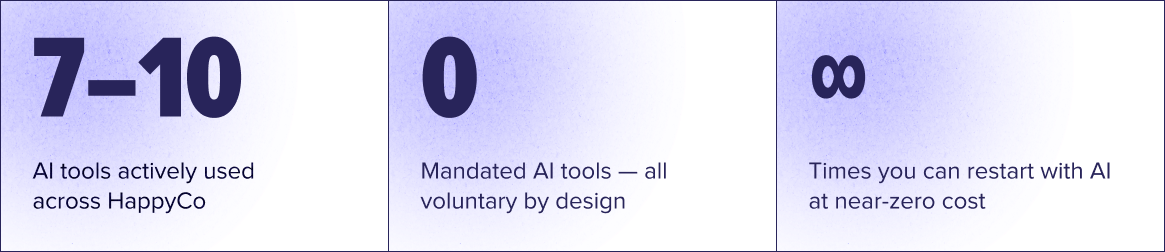
The panel’s prescription? Embrace imperfection. Stop waiting for a clear winner. There won’t be one — at least not anytime soon. HappyCo itself uses 7–10 different AI tools across departments simultaneously, without mandating a single platform, precisely because the landscape is still shifting.
Leadership Tip
The transition from fear to acceptance doesn't happen through persuasion — it happens through direct experience. The single most effective thing a leader can do is create a low-stakes environment for their team to experiment with AI tools.
Consider kicking off every team meeting with a two-minute “AI learning share.” This gives your team a consistent, low-pressure opportunity to share their discoveries. Ben likes to share his findings in Slack channels.
Culture Eats AI Strategy for Breakfast
One of the session’s sharpest insights came from Jindou, who reframed the entire AI adoption challenge as a culture problem, not a technology problem. If your organization is comfortable with the status quo, any change — AI or otherwise — will face resistance. But if your organization has internalized change as a core muscle, AI integration becomes just another iteration.
“If you have an organization that is good with the status quo, then change becomes really hard. If you are open to changing, then change is just part of what you do. You become really good at it.” — Jindou Lee | CEO & Co-Founder, HappyCo
Jindou described HappyCo’s internal philosophy: embrace uncertainty. Road maps change. What was being built last month will look different next month. The teams that thrive are the ones who can say “that didn’t work, let’s try something else” without blame, without finger-pointing, and without ego getting in the way.
For property management organizations, the parallel is direct. On-site teams who’ve been operating the same way for a decade aren’t resistant to AI — they’re resistant to uncertainty. Leaders who create psychological safety around experimentation will move faster than those who mandate a single approved tool.
What Leadership Must Do First
Sukhi then posed a critical question to the group: What organizational truths must be in place for AI adoption to truly succeed?
- Leadership must believe AI is important — not just say it.
- Every team must get the right tools, training, and encouragement.
- Slower adopters can’t be abandoned — they need support, not pressure.
- Fast movers can’t be held back waiting for everyone to catch up.
Security Imperative 101
Before letting any AI tool get its hands on client data, you need a rock-solid security and compliance plan. Document every step, assign who's in charge, and create a process you can repeat. While moving fast with new tools is tempting, it should never jeopardize client data privacy. Think of your security review as the gatekeeper and your culture of experimentation as the high-powered engine. One can't work without the other.
The Shift from AI to Agents — and Why It Changes Everything
The most forward-looking portion of the conversation centered on AI agents — and Jindou made a clear distinction that’s worth understanding. Conventional AI, he explained, is essentially a very smart Q&A system. You ask it things, it tells you things. Agents are fundamentally different: they work for you.
“Imagine designing the 24/7, 365 worker. You’re not limited by time anymore. These agents are working 24/7, and they can do anything — with an expert-level skill — and work nonstop.” — Jindou Lee | CEO & Co-Founder, HappyCo
The Multi-Agent Team Model
The vision painted was of a personal AI team: a product manager, a software developer, a designer, and a McKinsey-style analyst — all running in parallel, all working while you sleep.
Ben added a real-world illustration: in a recent customer meeting, he was simultaneously in the conversation, having Claude write a white paper, researching work structures, and thinking through pricing. This kind of multi-threaded productivity would have been impossible two years ago.
The Agent Opportunity for Multifamily
➔ AI agents don’t just answer questions — they execute tasks continuously on your behalf.
➔ One operator could effectively manage a team of specialists (PM, analyst, designer) running around the clock.
➔ For onsite teams, this means administrative and repetitive tasks can run in the background while humans focus on residents.
➔ This is less Lord of the Rings, more Thanos collecting gems: multiple specialized agents working in concert.
The Emerging Agent Team Structure
Research & Analysis Agent
Processes market data, compiles competitor intelligence, synthesizes industry reports, and generates insight briefs on demand. Replaces hours of reading and synthesis work.
Development Agent
Writes, tests, and iterates code. HappyCo is already shipping product updates accelerated by AI coding agents — dramatically compressing time from idea to deployment.
Content & Communication Agent
Drafts white papers, presentations, and policy documents. Turns a rough outline into a polished document in minutes, not days.
Strategic Advisor Agent
Reviews decisions for blind spots, models scenarios, challenges assumptions. The equivalent of a consultant on retainer — available at any moment, never billable by the hour.
Key Insights
Start experimenting with AI agents now — not AI chatbots. The distinction matters. Agents take direction and execute tasks autonomously. The companies getting comfortable with them today will have a compounding advantage in 24 months.
What if You Were Always in the Room?
Sukhi posed one of the session’s most evocative thought experiments: what would it look like if you, as a leader, were present for every single interaction in your organization? The maintenance tech dealing with an irate resident. The manager losing patience with a vendor. The online review session where a resident went off on someone who didn’t deserve it.
What if your judgment, your coaching instincts, your standards — could be present everywhere, at every moment, without you physically being there?
“What if your approach — what got you to be in the room — was now a capability that could go down to everyone in the organization at precisely the right moment?” — Sukhi Singh | CSO, HappyCo
An audience member crystallized it beautifully: she doesn’t want to be in every room with a fix. She wants her team to have the skills, confidence, and decision-making power to handle things themselves. The role of AI, then, isn’t to replace judgment — it’s to scale it. To make the five-star review behavior repeatable and consistent, not dependent on which team member happened to be on shift.
“Consistency is what drives your brand. With AI, we’ll all be able to focus on things that really matter — how we show up to our residents, to clients.” — Jindou Lee | CEO & Co-Founder, HappyCo
The End Goal: More Time for What Matters
Near the end of the session, the conversation arrived at its most human moment. Sukhi recalled a line from an earlier Happy Summit session: the maintenance technician is the ambassador of the property. That person’s interactions with residents shape how people feel about where they live.
“The maintenance tech isn't just fixing things — they're the ambassador to that community. Our job is to give them 20 more minutes a day to actually be that ambassador.” — Sukhi Singh | CSO, HappyCo
So if AI and agents can absorb the administrative weight — the data entry, the work order categorization, and the after-hours triage — what does that free up? Ten extra minutes per day. Twenty. An hour. Time to have a real conversation. Time to build the relationship that turns a resident into a long-term advocate.
“What we’re trying to do — starting from the maintenance side — is really help your teams get away from the drudgery. We want to allow our customers to have all the time in the world to have that relationship.” — Jindou Lee | CEO & Co-Founder, HappyCo
This, ultimately, is the through-line of the entire conversation: AI is not about replacing people. It’s about removing the drudgery so that people can do the thing that actually moves the needle — connect, empathize, serve, and build community.
Lauren Seagren is the Content Marketing Specialist at HappyCo, where she leads the company’s content strategy and storytelling across channels. She develops and optimizes campaigns, blogs, case studies, and enablement materials, while building the systems that help content scale and align across teams. Prior to HappyCo, Lauren led content and brand strategy across SaaS startups, creative agencies, and growth-stage companies, bringing more than a decade of experience driving measurable growth across B2B and B2C organizations.


