


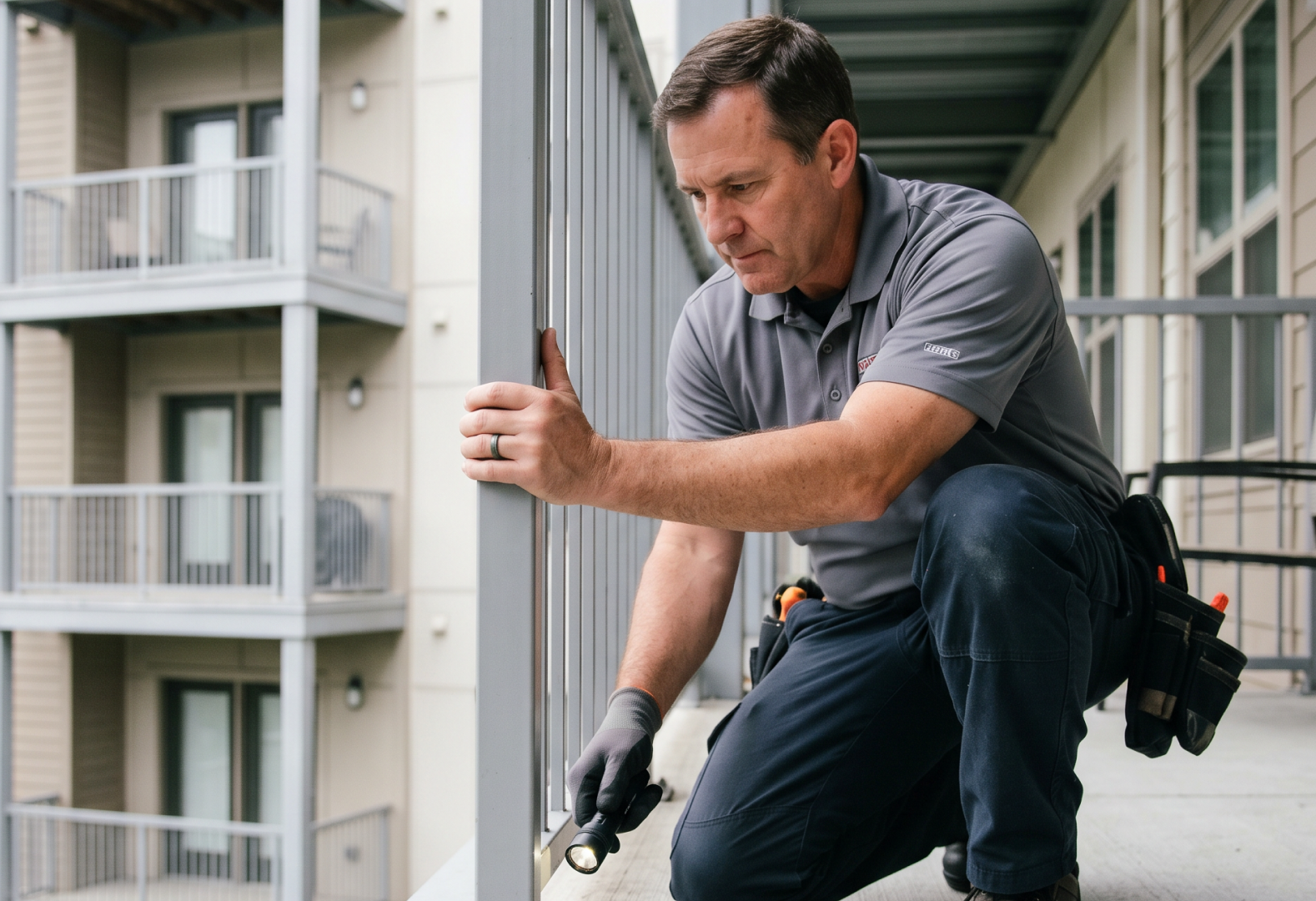


Balcony safety isn't something multifamily owners and operators can afford to treat as an afterthought. One overlooked crack, one corroded railing anchor, one blocked drain — and you're looking at a structural failure that puts residents at risk, triggers expensive repairs, and exposes your organization to serious liability. This guide walks through what a balcony inspection actually involves, the regulations you need to track, and how a standardized inspection program protects both your residents and your bottom line.
What Is a Balcony Inspection?
A balcony inspection is a professional assessment of an exterior balcony, deck, walkway, or stairway to evaluate structural integrity, safety, and code compliance. A qualified inspector examines structural components, surface materials, drainage systems, railings, and connection points to flag deficiencies before they become hazards.
Why Balcony Inspections Are Critical for Multifamily Properties
Balcony failures rarely come with warning signs. By the time damage is visible, structural deterioration has often been building for months — sometimes years — which is exactly why proactive inspection programs matter.
Structural Safety & Risk Prevention
Balconies take continuous abuse from rain, UV exposure, freeze-thaw cycles, and daily foot traffic. A hairline crack in a concrete slab or light rust on a steel anchor can quietly worsen for years without any visible sign. A proactive inspection program is the most reliable way to catch these issues before they reach failure.
Legal & Compliance Requirements
Several states have enacted mandatory inspection laws for exterior elevated elements. California's SB 721 requires owners of wood-supported balconies, decks, and walkways on buildings with three or more rental units to complete inspections every six years — the original deadline was extended to January 1, 2026 under AB 2579. California's SB 326 applies the same general framework to condominiums and HOAs on a nine-year cycle, with its first deadline also set at January 1, 2026.
Florida's Senate Bill 4-D, passed after the 2021 Surfside collapse, requires milestone structural inspections specifically for condominium and cooperative buildings three or more habitable stories tall, once they reach 30 years from their certificate of occupancy date (25 years for buildings within three miles of the coast in some jurisdictions). Noncompliance can mean daily fines, forced restrictions on occupancy, and serious legal exposure.
Preventing Costly Repairs & Liability
A repair that costs a few hundred dollars today can turn into a full structural replacement costing tens of thousands if it's left alone. Beyond the repair cost itself, a balcony failure that injures a resident can mean personal injury litigation and reputational damage that affects occupancy for years. Regular documentation also creates a defensible record showing your organization exercised reasonable care.
Balcony Safety Regulations & Compliance Requirements
Balconies are primarily regulated at the state and local level in the US, with the International Building Code (IBC) serving as the model code most jurisdictions build from. Here's what to track:
- California SB 721 requires inspection of wood-supported exterior elevated elements on rental properties with three or more units, every six years, by a licensed structural engineer, architect, or qualified contractor.
- California SB 326 applies a nine-year inspection cycle to condominiums and HOAs, with inspections limited to licensed structural engineers or architects.
- Florida SB 4-D requires milestone structural inspections for condominium and cooperative buildings three or more habitable stories tall, triggered at 30 years from the certificate of occupancy date (25 years in some coastal jurisdictions).
- IBC standards require balconies 30 inches or more above grade to have a minimum railing height of 42 inches, with balusters spaced no more than 4 inches apart.
If your portfolio spans multiple states, maintain a compliance calendar that tracks inspection deadlines and documentation requirements property by property — the cycles and qualifying criteria differ enough between jurisdictions that a single blanket schedule won't hold up.
Apartment Balcony Inspection Checklist
Structural Integrity Checks
Start with the load path and connections — if those fail, every other repair downstream is wasted effort.
- Inspect framing for rot or gaps in joists, beams, and ledger connections.
- Check hardware for rust or loose bolts, and flag undersized or missing connectors.
- Probe for soft wood with moisture meters, and listen for hollow spots with a light hammer tap.
- Rate urgency for each finding (immediate versus within the month) and photograph every issue with a clear tag.
Surface & Flooring Inspection
Surface damage is usually the first visible sign of a waterproofing failure underneath.
- Check for bouncing or uneven boards, and look for cracked tiles or peeling membranes.
- Look for ceiling stains below the unit or blisters near the deck surface — both point to active leaks.
- Photograph every finding with a unit number or location tag attached.
Railing & Guardrail Safety
Railings exist to prevent falls, and code compliance here isn't optional.
- Test for looseness, confirm handrails are structurally sound, and verify baluster gaps meet code.
- Confirm railing height is at least 42 inches and baluster gaps don't exceed 4 inches.
- If a railing feels unsafe, restrict access to the area immediately and bring in a structural engineer to test pullout strength before clearing it for use.
Drainage & Waterproofing
Proper slope keeps water moving off the surface — standing water rots wood and breaks down membranes fast.
- Confirm the floor slopes away from the building wall, and check that drains are clear and flashing is snug.
- Check for leaks from clogged drains or dried-out sealants, and look for pooling water after rain.
- Share photos of pooling, flashing condition, and drain outlets directly with contractors before scheduling repairs.
Fixtures & Attachments
Heavy or temporary additions affect load and waterproofing in ways that aren't always obvious until something fails.
- Check anchors for rust and look for fasteners pulling away from their mounts.
- Note whether attachments are permanent or removable, and record weight limits for anything non-permanent.
- Photograph any resident-installed items, and ask residents to remove anything that poses a clear safety risk.
Balcony Risk Assessment: Identifying Potential Hazards
A balcony risk assessment goes further than a visual inspection — it weighs the likelihood and consequences of different failure modes so your maintenance resources go where they're actually needed. Key factors include building age, how heavily residents use the space, environmental exposure (coastal properties see accelerated corrosion from salt air), and whether unauthorized modifications have been made.
Risk levels generally fall into three categories:
- Low risk — monitor at the next scheduled inspection.
- Moderate risk — repairs required within a defined timeframe.
- High risk — immediate action required, with access restricted until remediation is complete.
Any balcony posing an immediate risk of falling or collapse should be taken out of service until repairs are made — no exceptions.
Common Balcony Issues Found During Inspections
- Cracks & structural weakening — surface cracks in concrete can signal carbonation, rebar corrosion, or freeze-thaw damage happening from the inside out.
- Rust & corrosion — once corrosion reaches structural fasteners or embedded reinforcing steel, the safety risk escalates fast.
- Loose railings — a railing that looks intact but has corroded anchor bolts can fail suddenly under load. This is the most frequently cited immediate hazard in field inspections.
- Water damage & leaks — failed waterproofing, clogged drains, and gaps in flashing cause wood rot and concrete deterioration over time, making this the most pervasive long-term threat to structural integrity.
- Overloaded balconies — most residential balconies are designed for 40–60 lbs per square foot, and heavy furniture, grills, and storage boxes accumulate fast enough to exceed that limit without anyone noticing.
How Often Should Balcony Inspections Be Conducted?
Recommended Inspection Frequency
For most multifamily properties, a full inspection every three to five years is a reasonable baseline where no state mandate applies. Where state law governs — California's six-year SB 721 cycle, for example — that schedule takes precedence over any internal baseline.
Factors Affecting Frequency
- Coastal buildings see accelerated corrosion and need more frequent attention, sometimes annually.
- Properties in freeze-thaw climates face faster material breakdown from seasonal cycling.
- Older construction (30+ years) and buildings with a documented history of water intrusion both warrant a shorter inspection interval.
Preventive vs. Reactive Inspections
Preventive inspections run on a fixed schedule. Reactive inspections get triggered by resident complaints, visible damage, or severe weather events. A sound inspection program includes both — relying on either one alone leaves gaps.
Seasonal & Weather Considerations
Post-winter inspections are especially valuable in northern climates, where freeze-thaw cycles cause some of the most significant balcony damage. In hurricane-prone regions, post-storm inspections should be standard practice after every major weather event.
Balcony Inspection Process (Step-by-Step)
- Initial visual inspection: Walk every balcony looking for obvious problems — visible cracking, corrosion, standing water, damaged railings, or deteriorated surfaces.
- Thorough structural inspection: A qualified inspector gets hands-on, testing railings, probing wood for rot, and inspecting hardware. Intrusive investigation may be required to evaluate hidden framing.
- Documentation & reporting: Every finding gets documented with photos, descriptions, and location references, along with severity ratings and recommended corrective action.
- Repair & maintenance planning: High-risk items get addressed immediately, moderate-risk items get scheduled, and low-risk items get flagged for ongoing monitoring.
- Follow-up inspection: Confirms the work was done properly and no new issues have emerged since the last pass.
How Balcony Inspections Impact Property Value & ROI
Cutting Long-Term Maintenance Costs
It's dramatically cheaper to catch a waterproofing failure before it causes extensive rot than to deal with the downstream damage later. A consistent inspection and maintenance program lowers total cost of ownership across a building's lifespan — the math works in your favor every time.
Enhancing Resident Satisfaction and Retention
Residents notice when a property is well maintained. Secure, attractive balconies translate into higher satisfaction and lower turnover — and preventing a serious incident also protects against the kind of reputational damage that follows a high-profile safety failure.
Protecting Property Value
Current inspection records matter to lenders, insurers, and anyone running due diligence on a potential acquisition. Deferred balcony maintenance is one of the most common red flags that surfaces in commercial real estate transactions.
Challenges in Managing Balcony Inspections at Scale
Scaling balcony inspections across an entire portfolio creates real friction, and most of it comes down to coordination, not the inspections themselves.
- Stagger inspections across multiple fiscal years when permit backlogs or limited inspector availability slow down your timeline.
- Standardize your template across every property — inconsistent photo tagging or mismatched report formats make it nearly impossible to rank repairs against each other.
- Group resident communications together for properties undergoing inspection at the same time, since one-off scheduling conversations eat up disproportionate staff time.
How to Streamline Balcony Inspections in Property Management
- Use the same checklist across every property in your portfolio. When photo tags link directly to a repair schedule, urgent fixes reach maintenance crews without delay.
- Centralize inspection data in software that connects to your existing workflows, so flagged balcony issues become work orders automatically instead of requiring manual re-entry.
- Choose inspection vendors based on their mobile reporting capability — strong field tech means reports flow directly into your work order and reserve study files without manual cleanup.
FAQs
Who Is Responsible for Balcony Inspections?
In most multifamily rental properties, the building owner or property management organization is responsible. In condo associations, responsibility may be split between the HOA, which covers common areas, and individual unit owners, who cover exclusive-use balconies — the exact split depends on governing documents and state law.
Are Balcony Inspections Legally Required for Multifamily Properties?
Yes, in several states. California requires inspections under SB 721 for rental properties and SB 326 for condominiums and HOAs. Florida requires milestone structural inspections under SB 4-D for condominium and cooperative buildings three or more habitable stories tall, once they reach the applicable age threshold. Always verify current requirements with your state and local building department, since deadlines and qualifying criteria have shifted through subsequent legislation in both states.
How Often Should Balconies Be Inspected?
Follow your state's mandated schedule where one applies — six years under California's SB 721, for example. Where no state mandate applies, inspect every three to five years at minimum, and more frequently for high-risk properties.
What Happens if a Balcony Fails Inspection?
Immediate hazards require restricting access until repairs are complete. Less urgent findings get addressed on a defined timeline. Ignoring documented deficiencies significantly increases your liability exposure if something fails later.
How Much Does a Balcony Inspection Cost?
A basic inspection can range from $200 to $500 per unit. A full exterior elevated element inspection of a large multifamily building, performed by a licensed structural engineer, can run several thousand dollars. Portfolio-wide programs are often priced on a per-unit basis.
What Are the Key Balcony Safety Regulations for Apartments and Multifamily Properties?
California's SB 721 and SB 326, Florida's SB 4-D, and local codes built on the International Building Code, covering minimum railing height (42 inches), baluster spacing (4 inches maximum), and structural load capacity. Track each jurisdiction's deadlines separately, since the qualifying criteria and cycles differ between them.
This article is for general informational purposes and reflects publicly available information on state and local inspection requirements as of mid-2026. It does not constitute legal advice. Inspection deadlines, qualifying criteria, and compliance requirements are subject to change through subsequent legislation — consult your legal counsel and local building department to confirm current obligations for your specific properties.
Lauren Seagren is the Content Marketing Specialist at HappyCo, where she leads the company’s content strategy and storytelling across channels. She develops and optimizes campaigns, blogs, case studies, and enablement materials, while building the systems that help content scale and align across teams. Prior to HappyCo, Lauren led content and brand strategy across SaaS startups, creative agencies, and growth-stage companies, bringing more than a decade of experience driving measurable growth across B2B and B2C organizations.


