


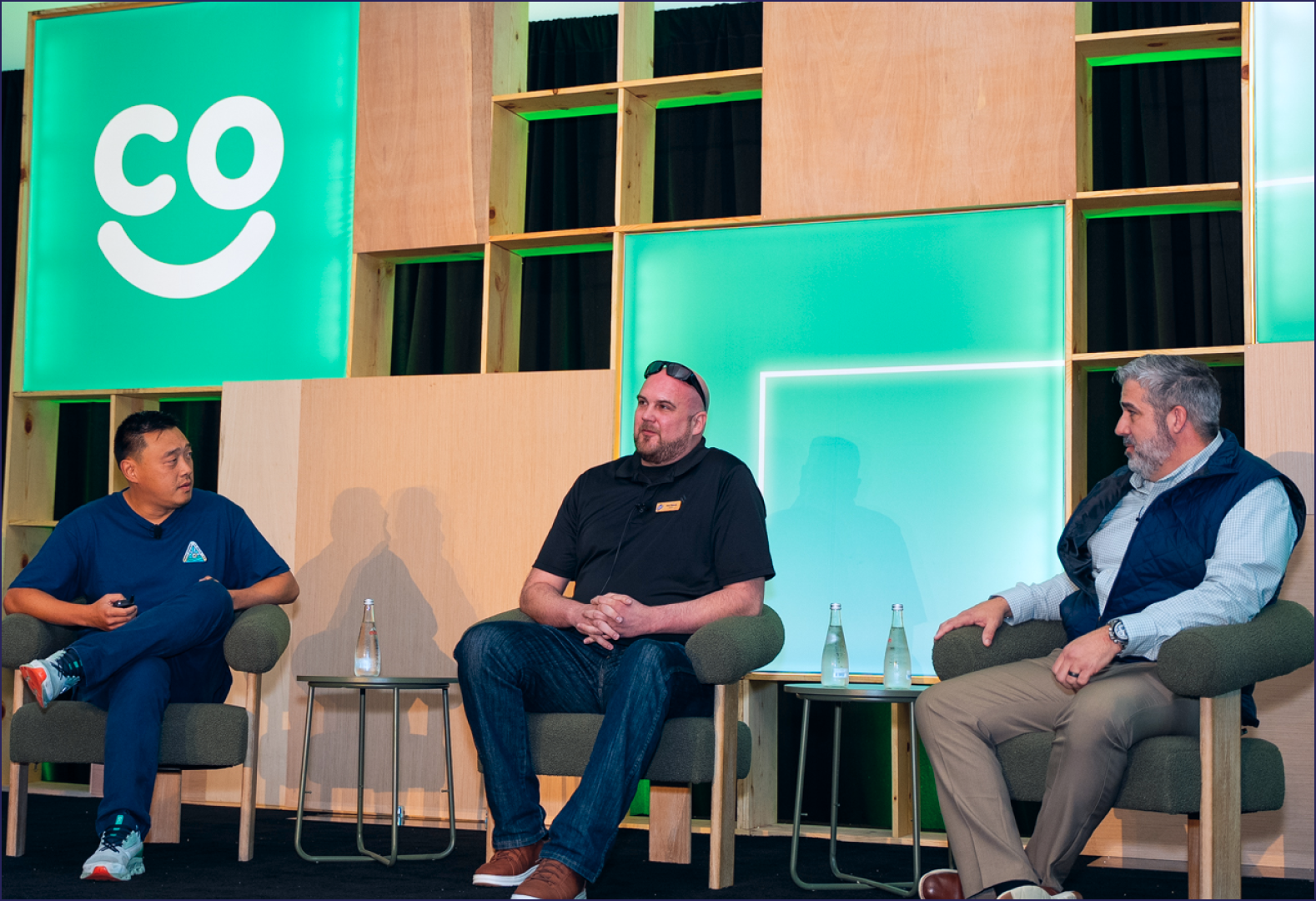


The Session That Cut Through the Hype
The multifamily maintenance industry is at a crossroads. Chronic labor shortages, an aging workforce, and rising resident expectations are colliding with a wave of AI and digital tools that promise to reshape how properties are staffed, managed, and serviced. At Happy Summit 2026, two veterans — Rick Picquet and Jason Simmons — Directors of Maintenance at Bell Partners and Fairfield Residential, respectively — didn't sugarcoat any of it.
This session wasn't about hype. It was about the reality of running 80,000 units across 16 markets and figuring out where technology helps, where humans are irreplaceable, and how to build teams that can thrive in both worlds. They sat down with HappyCo's CEO & Co-Founder Jindou Lee to unpack what's actually working on the ground.
The Crisis You Can't Automate Your Way Out Of
Before we can talk about AI's role in maintenance, we have to confront the reality of the workforce reality it's operating in — because it's genuinely alarming.
Turnover in multifamily maintenance runs at 40% annually. Not industry-wide average. Not a down-cycle anomaly. Forty percent, every single year. That means nearly half your maintenance team is turning over in any given twelve months.

The pipeline problem is even starker: for every four open maintenance roles, only one new technician is entering the field. Supply is not meeting demand, and the gap is widening.
“For every four open roles, there's only one new technician coming into the space. That is crazy.” — Jindou Lee | CEO & Co-Founder, HappyCo

Why? The workforce is aging out. Approximately 40% of skilled tradespeople are over 45 — a demographic cliff is approaching as these experienced professionals retire, taking with them decades of irreplaceable institutional knowledge. The kind of knowledge that sounds like: "That HVAC unit, tap it three times on the left and four times on the right and it fixes itself." You cannot put that in a manual. You cannot prompt-engineer it out of an LLM.
Meanwhile, fewer and fewer workers under 25 are entering the trades. The cultural narrative around "good careers" has steered young people toward knowledge work for decades — and now, as AI increasingly displaces that same knowledge work, the physical trades are looking more and more like the resilient career path they always were.
There are also a staggering 450,000 new apartment units coming online, with another 400,000+ in the pipeline — all of which will need maintenance teams. The math does not work. The upshot: the maintenance workforce crisis is structural, not cyclical. AI can help on the margins, but it cannot solve the fundamental problem of too few people with too few skills to meet growing demand.
Why This Matters for Operations
With 450,000 units expected to come online and another 400,000 projected in pipeline construction, the demand for maintenance talent is only growing. The workforce to fill those roles simply does not exist at current recruitment rates. Operators who don't rethink their hiring and retention strategy now will be left scrambling.
The Evolving Maintenance Role: More Than Wrenches
Here's something that often gets lost in workforce planning conversations: the maintenance technician of 2026 is a fundamentally different job than the maintenance technician of 2000. Maintenance staff are now the primary resident-facing touchpoint at most multifamily properties. They're the people residents interact with most frequently, most personally, and most consequentially.
The data bears this out: 78% of resident renewals are influenced by interactions with maintenance staff. Not leasing agents. Not amenities. Not even rent price, in many cases. The maintenance experience — whether the tech was friendly, communicative, whether the problem got fixed right, and whether the resident felt heard — is the primary driver of whether someone renews their lease. It also means the cost of a bad maintenance experience isn't just a busted faucet; it's a lease non-renewal and lost revenue. That changes everything about how you should hire, train, and manage maintenance teams.
“Your maintenance guys have to be able to fix everything — but they're also your Chick-fil-A. Forward facing, every day. That's who's fixing their problems. They're not the old-school grumpy guy anymore.” — Rick Picquet | Director of Maintenance, Bell Partners

Hiring for Attitude in a Scarcity Market
Given the workforce dynamics described above, how do experienced maintenance leaders actually hire? The answer involves a philosophically important shift: hire for character, train for competence.
Both Rick and Jason have moved away from treating technical knowledge as the primary hiring filter. Their reasoning is pragmatic: in a market where you're often choosing between imperfect candidates or leaving a role unfilled for months, eliminating someone because they don't yet know how to do a particular repair is a costly mistake when that knowledge can be transferred. You cannot, however, teach someone to be reliable, positive, resident-focused, and adaptable.
“Knowledge is something that can be taught. You can form that. But what you cannot form is their attitude. That they control.”— Jason Simmons | Director of Maintenance, Fairfield Residential
When you can't find experienced technicians, you have two choices: lower your standards or change your definition of "qualified." Rick and Jason choose the latter — and it's reshaping everything from job postings to interview techniques.
Rather than screening for years of HVAC or plumbing experience, their hiring process now centers on three things:
- Attitude — Can they show up with a positive, resident-first mindset?
- Aptitude — Do they have the curiosity and capacity to learn new skills quickly?
- Fit — Do they match the specific demands of the property type (mid-rise vs. garden style)?
“I'll ask them: you get a call at 2 a.m. for HVAC — walk me through from the call to the end. My goal is to get them relaxed and see what they're really like. I want to see their thought process. It’s to observe how they think, what they prioritize, and whether they approach problems methodically.” — Rick Picquet | Director of Maintenance, Bell Partners
Rather than relying solely on office interviews, Jason's team takes candidates on-site during the interview process — literally walking the property — to observe how they interact with residents and staff. It's a live audition, not just a conversation.
Practical Tip: The On-Site Interview
Watch how they greet residents, respond to unexpected questions, and carry themselves in the space. For senior-living communities, you want someone patient and warm. For a busy mid-rise, you need fast thinkers who can pivot from different technical problems such as elevator issues all the way to fire safety systems in the same afternoon. Matching candidates to the right environment dramatically improves both performance and retention.
How AI Is Actually Being Used in Maintenance Teams Today
This portion of the discussion moves away from abstract theories and into practical, candid insights — offering significantly more value than typical AI commentary.
Jason is direct about how his teams actually use AI today, "I'll use it to help diagnose complex equipment issues. I'll use it to give me a preview outline for PowerPoints. I use it pretty often now. The way I see it — you can put a screw in with a screwdriver, you get it done, but a drill will be faster."
“You can put a screw in with a screwdriver and get it done. But a drill is faster. Using the tools you have — that's the point.” — Jason Simmons | Director of Maintenance, Fairfield Residential
That's not a revolutionary statement. It's an accurate one. And it points to a more grounded ways of thinking about AI adoption in maintenance operations:
Diagnostic support: Technicians are already using ChatGPT and similar tools to diagnose complex equipment problems. Feed in the symptoms, the equipment model, the error codes, and get back step-by-step troubleshooting guidance. This is YouTube for a new era — and it's genuinely accelerating how quickly even less experienced technicians can work through unfamiliar problems.
Training acceleration: AI's diagnostic support has a compounding effect on skill development. New technicians who use AI tools as training aids are building competency faster than previous generations who had to rely entirely on formal training or mentorship. They're also more resilient when they encounter equipment they've never seen before — they have a tool to help them reason through it.
Documentation and workflows: HappyCo's digitization of work orders, inspections, and unit turns has had a dramatic measurable impact. One team reported 140,000 additional work orders completed after implementing proper category and subcategory structures in work orders — not because more work was being done, but because work was being documented and tracked properly. The AI-enhanced data capture revealed work that was happening but going unrecorded, which in turn improved budget forecasting, capital planning, and accountability.

After-hours triage: Happy Force, HappyCo's AI-powered after-hours call response, is taking a significant load off maintenance teams by handling initial resident contact, triaging urgency, and routing genuinely urgent issues to on-call technicians. This directly addresses one of the leading causes of technician burnout — the 2 a.m. call that turns out to be a resident asking about a burned-out light bulb.
Case Study: From Flip Phones to 97% Compliance
One of the more striking moments in the session involves Rick's recollection of rolling out HappyCo's digital platform to his maintenance team — a team that included experienced technicians who had never owned a smartphone. "We literally had maintenance managers with flip phones. So not only did they have to learn a new technology, they had to double down on it — they had to learn to swipe."
“Maintenance folks are not really change-friendly. We literally had maintenance managers with flip phones — they had to learn to swipe. I became really good at iOS just because I had to show them.” — Rick Picquet | Director of Maintenance, Bell Partners
Today, that same team is running at 97% compliance on digital work order usage. In nine months. That arc — from flip phone resistance to near-universal adoption — contains important lessons about change management in maintenance operations: start with the basics and go from there, utilize tech-native younger technicians serve as accelerants by assisting older colleagues and fostering a culture of experimentation, and establish feedback loops with field technicians allows for continuous workflow improvements, enhancing both data quality and team buy-in.

The Future: Drones, Robots, & the Irreplaceable Human
To wrap up, the session featured an engaging look at the road ahead, highlighting where physical automation excels and where its boundaries lie.
AI diagnostics will continue improving. The expectation is that AI tools will further lower the skill floor for entry-level technicians, making it possible to hire a broader candidate pool and develop them faster. This doesn't eliminate the need for skilled, experienced technicians — it makes skilled technicians more effective by giving them better tools, and it makes less-skilled technicians more capable by giving them structured support.
The physical work remains irreplaceable. Nobody is building a robot that fixes a leaky drain, rewires a thermostat, replaces a garbage disposal, and then reassures the anxious resident while documenting the work on a smartphone. Physical work still requires humans. The opportunity is to make the AI as efficient as possible so that the humans doing the physical work can do it better, faster, and with less stress.
What's Next: Future Tech on the Horizon
Rick and Jason called out drone delivery of parts as the innovation they’re most excited about next — eliminating the biggest source of technician downtime (waiting on supplies). Jason pointed to autonomous painting robots for capital projects as a real opportunity to accelerate timelines and reduce labor costs on repetitive tasks.
Both agreed: these tools complement skilled trades, they don't replace them.
Lauren Seagren is the Content Marketing Specialist at HappyCo, where she leads the company’s content strategy and storytelling across channels. She develops and optimizes campaigns, blogs, case studies, and enablement materials, while building the systems that help content scale and align across teams. Prior to HappyCo, Lauren led content and brand strategy across SaaS startups, creative agencies, and growth-stage companies, bringing more than a decade of experience driving measurable growth across B2B and B2C organizations.


